
Built, Not Born
Happy Friday, Sippers,
⚡ TL;DR | Why brand resilience isn't an inherited gene or an acquired budget line; it's a muscle trained through falling, daily micro-experiments, and an Explorer Mindset.
How was your week?
Missed me?
Before we start, I did not expect the last edition to touch you this much. Thank you for your notes. I didn't think I was being brave until you told me. But it did make me think about resilience, which is the topic of this week's sip.
Mine was energized by a double dose of morning pour-over coffee and a manuscript that landed on my desk, written by my wonderful friend and Google colleague, JP Gauthier.
If you've been sipping with me for a while, you know JP as the mastermind behind our Google Montreal appreciation nights and a constant champion of teams.
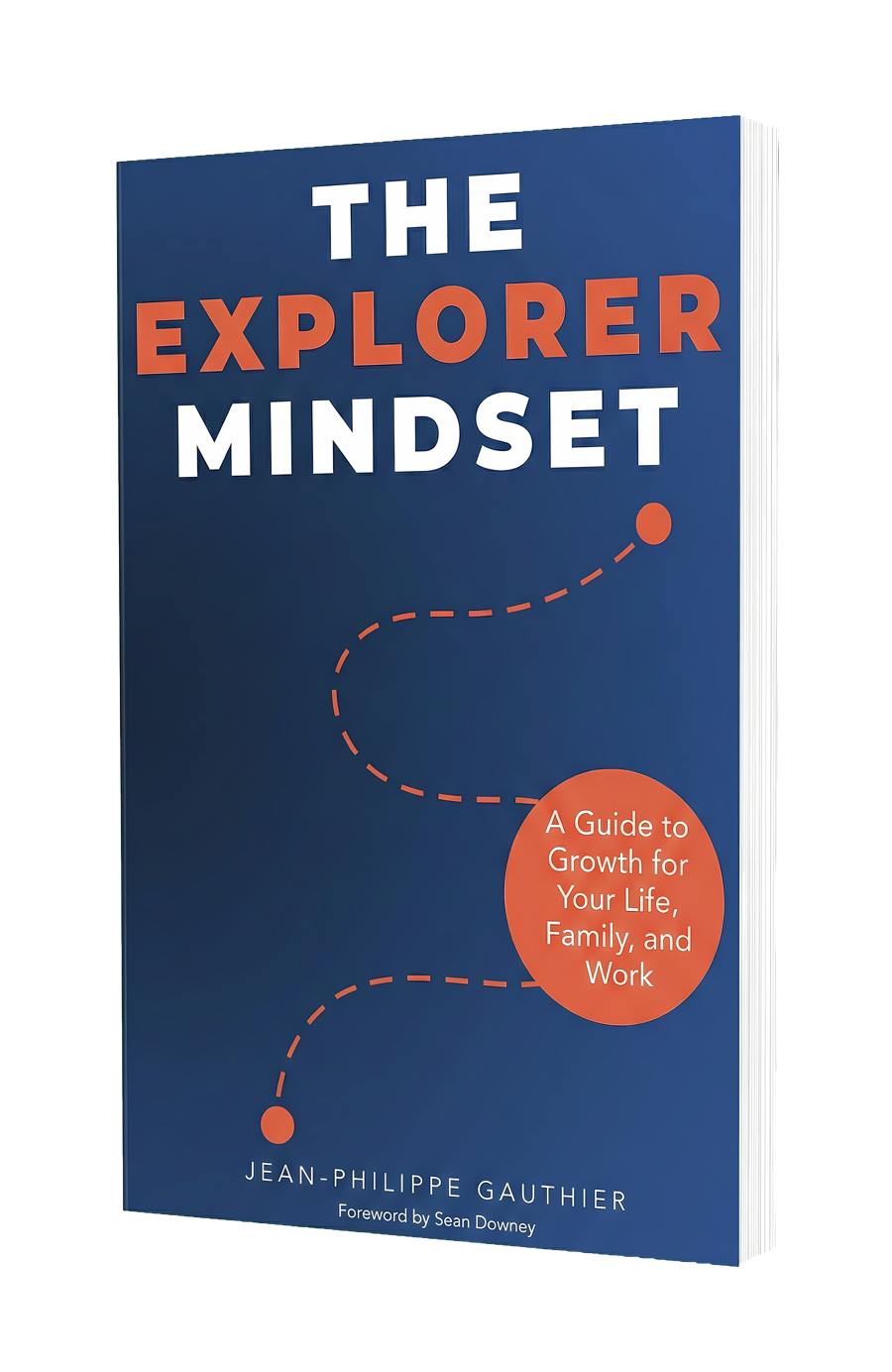
He just published The Explorer Mindset: Unlock an Explorer Mindset for Work, Family, and You. It started as a deeply personal compass for his kids, Anaïs and Louis, and his late brother Mathieu's boys, Jules and Samuel.
But as I devoured the pages, I found myself nodding, highlighting, and doing what I always do: translating human truths straight into brand building.
Because when you look across our industry right now, every leader is asking for one thing: Resilience.
In a market defined by tech whiplash and algorithmic shifts, we want our brands to be bulletproof. But too many leaders treat resilience like a commodity you can simply acquire, assuming that buying a bigger tech stack, hiring an agency, or raising a massive budget buys immunity against disruption.
It doesn't.
As Sean Downey (President, Americas & Global Partners @ Google) notes in his foreword to JP's book: "In today's world, Change is not just a scene in our story; it is the continuous narrative... We don't grow by avoiding risk. We grow by approaching risk with awareness and resilience."
Resilience is not an innate gift or a static asset you buy off the shelf; it is a skill that can only be learned, practiced, and strengthened through the messy act of exploration.
1. Resilience Is Learned, Not Inherited
In the book, JP shares a story about taking a genetic test for the DRD4-7R "wanderlust gene"; the supposed dopamine-driven biological ticket to risk-taking and exploration.
Spoiler alert | he tested negative. He didn't have the gene. And yet, his entire career and life have been defined by building the capacity to explore, pivot, and rebound.
The Brand Parallel | We love to look at iconic, unshakeable brands like Apple, Patagonia, or Nike and assume they possess some magical, inherent "bulletproof DNA". But brand resilience isn't an innate trait you're born with. You build it when you choose curiosity over judgment and train your organization to absorb negative signals without crumbling. You don't "inherit" resilience; you practice it daily on random, unglamorous Wednesdays.
2. Learn Through Falling | Reversible vs. Irreversible Decisions
One of my favourite chapters in JP's book explores learning through setbacks and a concept popularized on Google walls | Reversible vs. Irreversible Decisions
Irreversible Decisions | Rare, high-stakes bets (like enterprise architecture or major acquisitions) that require deep diligence.
Reversible Decisions | The vast majority of our daily choices, campaign tweaks, messaging hooks, channel pilots, where the consequences are temporary, and course-correction is easy.
The Brand Parallel | Brands lose their agility when they treat every single marketing choice as an irreversible crisis. Paralyzed by fear of failure, they fall into "comfort creep" and produce beige, safe sludge.
As JP writes, quoting Dr. Ellen Langer | "Is this a tragedy? Or an inconvenience?"
Resilient brands know how to fail fast on reversible bets. When an A/B test flops or a social hook misses, they don't treat it as a brand catastrophe; they treat it as an inexpensive data point that fuels the next iteration.
3. Exploration is a Team Sport: The 10% Living Lab
Sean Downey makes a critical point in the foreword: "Experimentation only happens when people feel psychologically safe enough to try." Exploration isn't a solo pursuit; it thrives in environments of trust and collaboration.
JP highlights that roughly 98% of people default to the familiar, and corporate business models inevitably get caught in comfort zones until a crisis forces change.
His antidote? Operationalize exploration by dedicating at least 10% of your budget and time to pure experimentation.
The Brand Parallel | Look at Toyota's Andon Cord (where anyone on the line can pull the cord to flag a glitch without blame) or Spotify's autonomous Squads. Resilient brands build internal psychological safety so their teams can run low-stakes probes before the market forces a painful pivot.
If 90% of your marketing budget protects the core engine, your 10% exploration fund is the insurance policy that keeps you from becoming obsolete tomorrow.
The Explorer Brand vs. The Static Brand
Dimension | The Static Brand | The Explorer Brand |
|---|---|---|
View on Change | A threat to be endured and resisted | A continuous narrative & competitive edge |
Approach to Failure | Conceals errors to protect an "expert" façade | Analyzes setbacks openly as fuel for growth |
Decision Velocity | Paralyzed by treating all choices as irreversible | Moves fast on reversible, low-risk micro-tests |
Resilience Model | Assumes brand equity is bought once and owned forever | Treats resilience as a daily discipline to be practiced |
☕ The Sip Takeaway ☕ 🍷🍸
Resilience is not something you buy in a pitch deck. It is the grit you build every time you stumble, reframe the fall, and decide to push off the ground again.
To build a brand that endures:
Ditch the Expert Complex | Adopt beginner's eyes. Question the status quo before your customers do it for you.
Normalize the Pivot | Run small, reversible experiments and celebrate the learning inside the failures.
Protect the 10% | Carve out the sandbox to explore, test, and play.
When you give your team the psychological safety to explore, you aren't just launching campaigns; you're building an unshakeable brand soul.
To JP | Congratulations on bringing this beautiful compass to life for Anaïs, Louis, Jules, and Samuel. The rest of us are lucky to borrow the map.
What's your brand's 10% experiment for next week?
See you next week,

(Check out JP's complete framework and book here: theexplorermindset.com/framework or drop him a note at jp@theexplorermindset.com!)
Comments